
SIGMA 18-35MM F/1.8 BREAKS THE F/2.8 BARRIER FOR ZOOM

SIGMA 18-35MM F/1.8 BREAKS THE F/2.8 LIGHT BARRIER FOR ZOOMS: REFLECTING ON APS-C VS FF
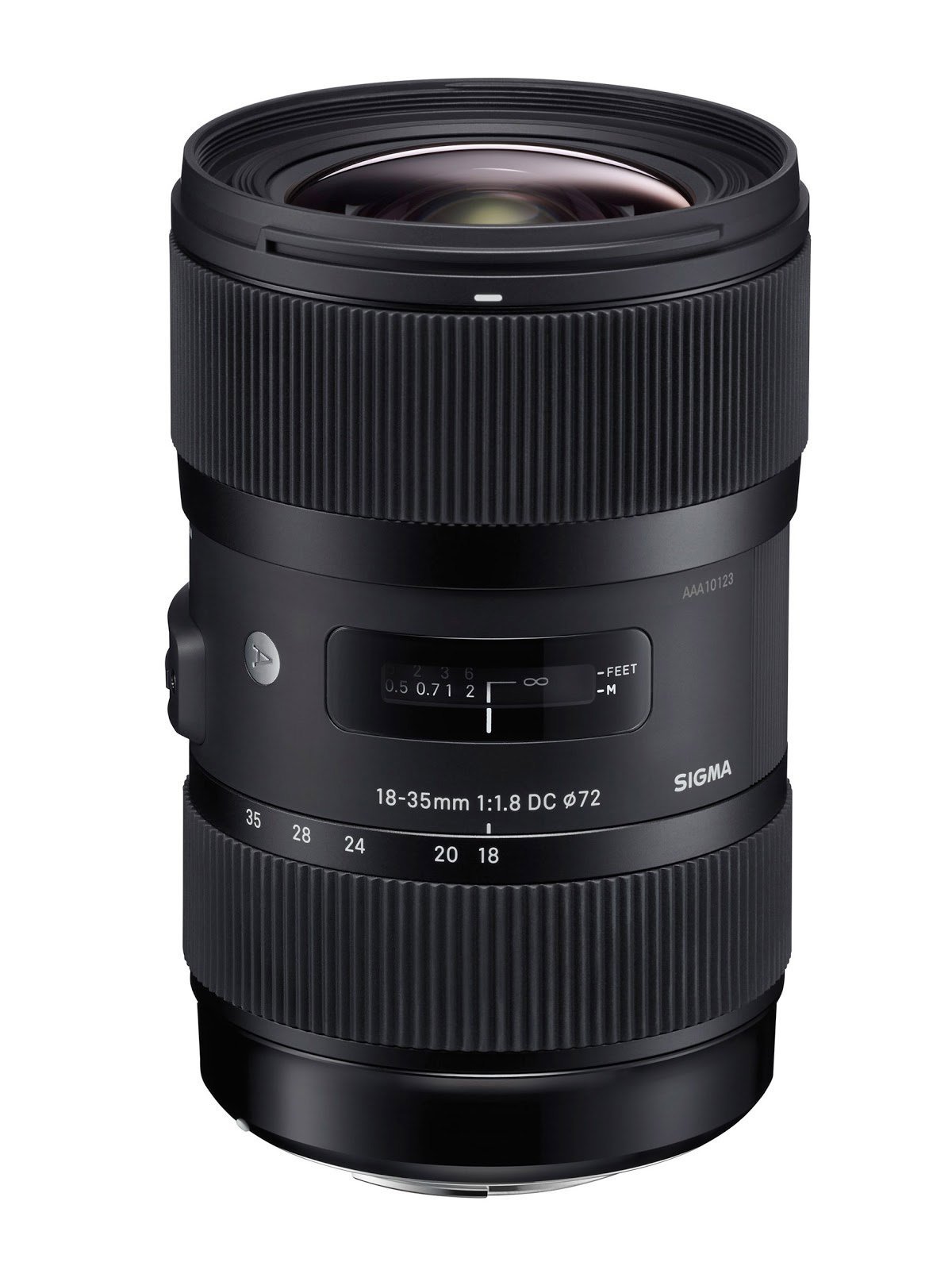
In what is a very interesting and revolutionary move, Sigma announced today their new Sigma 18-35mm f/1.8 DC HSM zoom, part of their new “Art” lens series. This super-fast, constant aperture zoom, covers APS-C sensors only. With its 79 x 122mm and 810 gr, the lens is small, compact and light enough for the fast aperture it features. As a reference, to give you an idea about its size, the Sigma 18-35mm f/1.8 DC HSM’s filter diameter is just 72mm, not the usual 77mm used by f/2.8 professional zooms.
The new Sigma’s main head-turning specification is its aperture. A constant aperture of f/1.8 on a zoom lens is a world-first, and a very impressive engineering achievement. On an APS-C camera, f/1.8 provides the same depth of field control of a f/2.7 aperture on full-frame DSLR cameras. However, the Sigma 18-35mm f/1.8 DC HSM’s f-stop is still a f/1.8 lens, so it allows you to shoot with shutter speeds 1 + 1/3 stop faster than, i.e., a 24-70 mm f/2.8 zoom on full-frame cameras at equivalent light levels and ISO.

What is most important, though, is that this lens opens up creative possibilities previously unavailable not only to APS-C users, but to any photographer in general in terms of shooting in low light. At the same time, it brings APS-C users the same level of depth of field control that full-frame users enjoy with their f/2.8 zooms.
Image-quality wise, at least on paper, the Sigma 18-35mm f/1.8 DC HSM is very good. Sigma’s MFT charts show that it’s very sharp across much of the frame already at f/1.8, with very low vignetting and just a hint of simple distortion.
Of course, real world performance has yet to be seen. However, at least on paper, the Sigma 18-35mm F1.8 DC HSM is a very impressive achievement for Sigma and one they need to be applauded for.
A quick bit of digital camera history. The format we call APS-C provides a crop factor of about 1.5x compared to what used to be the classic 135 (or 35mm negative size), the so-called “full frame” in today’s digital camera talks (FF from now on, or 24 x 36mm sensor size).
APS-C is the format all manufacturers used at the beginning of the digital revolution, basically due to cost containing and ease of production in sensor manufacturing.
Since then, Nikon, Canon, Sony and Leica eventually went on to produce FF cameras, while keeping some APS-C cameras in their line-up. Other manufacturer, like Olympus and Panasonic, went the other way from the start, developing 4/3 and micro 4/3 cameras (with a crop factor of 2x compared to FF), to profit from the reduction in size and weight that using a smaller sensor could bring. This variety in sensor formats would be fine, per se.
The problem, however, is with the lenses.
What does that mean? In short, and to keep it simple: APS-C’s 1.5x crop factor made tele-lenses users very happy. On APS-C, a 300mm f/2.8 lens suddenly gained the field-of-view equivalent (FOV equivalent from now on), and depth of field equivalent, of a 450mm f/4.2. Wide-angle (WA from now on) users, on the other hand, were not so happy: their legendary 17-35mm f/2.8 suddenly became a very bland 27-50mm f/4.2 FOV equivalent lens, losing some defocus control as well in the process.
Let’s look at prime lenses. Sure, primes kept working just fine even with a 1.5x crop factor. However, what is considered to be the “classical focal length spacing” suffered a bit. The old 28, 35, 50, 85, 105, 135, 180, 200, 300, 400, 500, 600 mm FF lenses, on APS-C now offer a FOV equivalent to that of 42, 52, 75, 127, 157, 202, 270, 300, 450, 600, 750, 900 mm lenses on FF. As you can see, APS-C users gain some in their tele range, loose some in their WA focal range and they get a strange, new spacing between lenses to get used to.

What did the big manufacturers do to fix the lack of APS-C wide-angle primes and WA & WA-to-normal zoom lenses? As well, what did they do to “fix” the FOV equivalency and focal length spacing for APS-C users? And, more importantly, what did they do to make their professional APS-C users happy?
Basically, they did too little, too late. No big manufacturer practically produced any new APS-C primes in the WA and Ultra-WA range, except for fish-eye lenses. Coming to zoom lenses, we saw a plethora of “18-to-something” APS-C consumer zooms, generally f/4.5-5.6 or similar, offered as kit lenses. We also saw the appearance of a few more “serious” lenses in the 17 to 50-55 mm range with fixed apertures of f/2.8 at first, to cover the old FF 24-70mm range. Later on, we saw lenses in the 11-12 to 24mm range with fixed apertures around f/4 to cover the 17-18 to 35mm range on FF. While some of them were quite good, these lenses generally provided less speed compared to lenses with the same FOV equivalent on FF, and even when they offered the same maximum f-stop, users got less defocus control.
Let’s see now what defines a professional-grade zoom lens. Well, some says that a professional lens is whatever lens a professional photographer uses to make money. True, of course. However, in my opinion such a lens must also feature:
– Constant aperture;
– Large maximum aperture (f/2.8 for shorter zoom lenses, traditionally, and f/4 for longer zoom lenses in the 200-400mm range);
– Non-rotating front element;
– Internal focus and preferably internal zooming as well;
– Distance scale;
– Fast autofocussing abilities;
– Weather-sealing;
– Solid build;
– Metal lens mount & possibly metal body as well;
– Image stabilisation and a good tripod collar & foot (especially for the longer focal lengths).
So why didn’t the big manufacturers offer anything much in the wide-angle and WA-to-normal segment of the market?
Basically, I think that there is one reason for this. When they entered the DSLR market, Nikon, Canon and then Sony knew that FF cameras would be there someday. So, rather than concentrating on developing new lenses for APS-C, they waited for FF to arrive. This way, they could:
– Move users from APS-C up to FF (creating upgrade sales = making more money);
– Save R&D and production costs on professional-grade APS-C lenses, thus making more money.
Third-party manufacturer, on the other hand, profited from the lack of efforts shown by the big guys and developed some interesting lenses in the WA range for the APS-C market. However, very few of these, if any, have been professional grade according to the definition above.
Until now, that is.

With their newly announced Sigma 18-35mm f/1.8 DC HSM zoom, Sigma finally produced a lens that offers BETTER light gathering capabilities at the same ISO than any FF zoom on the market, wide-angle or not, with the same depth of field control of FF zooms covering an equivalent field of view. They broke the constant f/2.8 light barrier for zoom lenses in the process, too, creating the world’s fastest constant zoom, a lens with an impressive constant aperture of f/1.8.
Thanks to Sigma’s efforts, now APS-C users have a lens with a focal length equivalent to 27-52 mm in FF with an aperture of f/1.8. A zoom with the same depth-of-field control of a 27-70 mm f/2.8 zoom but with 1.3 stop more speed (light gathering ability) at equivalent ISO. While performance remains to be seen, for all the reasons above, the Sigma 18-35mm f/1.8 DC HSM is a pretty impressive achievement already.
So, what does this mean for the camera market in general? According to Sigma at least, this means that APS-C is here to stay. Which leads to a different question: what are, really, the advantages of FF against APS-C, if any?
Traditionally, FF sensors had better light gathering abilities than APS-C sensors. They allowed the production of sensors with higher resolution, while limiting the downsides that using very small pixels and therefore having a very high pixel density creates. FF camera users have a wider lens choice, especially when it comes to wide-angle and Ultra-WA lenses.
With the progresses in sensor technology, however, keeping some particular applications aside APS-C is closing the gap, both in terms of light gathering and resolution. The most serious challenge left facing a professional APS-C user is the completeness or lack thereof) of pretty much every major manufacturer’s lens line-up.
I think that this announcement from Sigma is a game changer, and that it signals a new focus on APS-C. At least, I definitely hope so. On the one hand, I hope the Sigma 18-35mm f/1.8 DC HSM will be fantastic in terms of image quality in the real world as well (not just as far as its specifications on paper go), giving APS-C users a new creative tool up to their needing and expectations. One the other hand, and even more importantly, I hope this announcement will act as a wake-up call for Nikon, Canon and Sony, and that they will start taking APS-C more seriously. It would be about time.
Disclaimer: At the time of writing, I am not affiliated with Sigma in any way. I am a professional photographer looking for the best equipment for my work, I buy all my gear with my hard-earned cash and I don’t get paid by anyone to write articles for my blog.
Thank you for reading this post, I hope you enjoyed it! Why don’t you share it with your friends, or drop me a comment to let me know your thoughts about this?