
FINE ART LANDSCAPE & GFX100RF: A FIRST LOOK
AN UNEXPECTED & INTRIGUING PROPOSAL
“It might be interesting, if you think you would use it, to lend you a GFX100RF”. When FUJIFILM ITALY mentioned this, at first, I was sceptical. I shoot B&W large format film; I favour ultra-wide and wide-angle lenses; I work on a tripod all the time. Indeed, would I use it?
After all, the GFX100RF is a fixed-lens camera, with a 28mm FOV equivalent lens; a camera seemingly designed for street & travel, to be used hand-held; a camera offering features such as the image ratio selector, which while very cool I never thought I’d be interested in, since one can always crop in post-processing.
The proposal was as unexpected as it was intriguing, though, and it got me thinking. And then it hit me: the GFX100RF would be an amazing camera to carry with me during our next Workshop and traveling season, and I enthusiastically accepted FujiFilm’s offer. Let me tell you why I did it, what I thought about the camera upon receiving it and how I set it up for my work. Before going into that, though, let me extend my heartfelt thanks to the people at FujiFilm Italy for their kindness in lending me the GFX100RF for the months ahead.
Disclaimer: the GFX100RF is a free loan from FujiFilm Italy for the next 6 months. At the time of writing, I am not associated with FujiFilm in any way.

HOW DOES THE GFX100RF FIT IN WITH MY WORK | I do Fine Art landscapes, currently photographing exclusively in black & white, and since starting to work professionally with landscape photography in 2010, over the years I moved through different camera systems.
In 2020 I went back to Phase One, a system based on a field camera and digital back supporting only prime lenses. In 2021, I added an Achromatic digital back, which I have been using exclusively from 2022 on. In 2024, I moved back to film, and I currently use 4×5” Large Format cameras for my work.
My 4×5” cameras are even slower to work with than my previous digital kit, and also support only prime, manual lenses. Not only I am used to working within the limits of the medium I choose; I am actually inspired by those limits and by the slowness of the process, which I find stimulating and inviting a more reflective and deliberate way of photographing.
In the field, I love to walk into my locations, explore them and let the landscape tell me where to stop, and what to photograph. I love the contemplating part of my process; I love moving around to find just the perfect spot to set my tripod. I love to look at the sky and water, if present, and imagine how they would look with different exposures. I love to craft each of my photographs dedicating it all the time it needs, even if this means repeated visits to any given location.

The GFX100RF, with its fixed lens, is probably not the first camera a landscape photographer would typically look at; but, to me, the idea of having one to try out in the field for my work just clicked. Not “despite”, but exactly “because of” the constraints that having to work with a fixed lens impose.
THE CAMERA | The internet abounds with reviews of the GFX100RF, done either in controlled settings or in the field / street; however not many, if any, are done under a purely landscape-focusing approach. So, I thought it might be interesting to share with you my thoughts about the camera for my kind of work, and how I set it up for it.
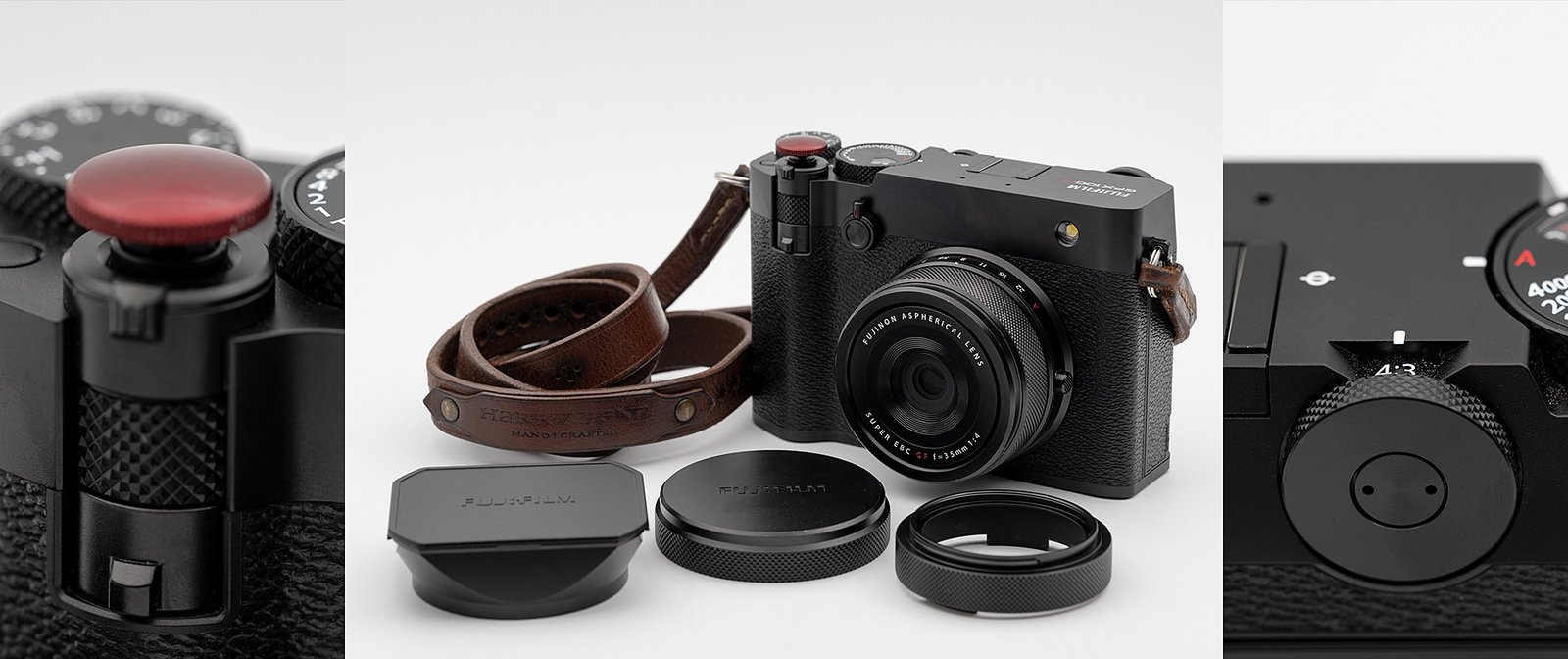
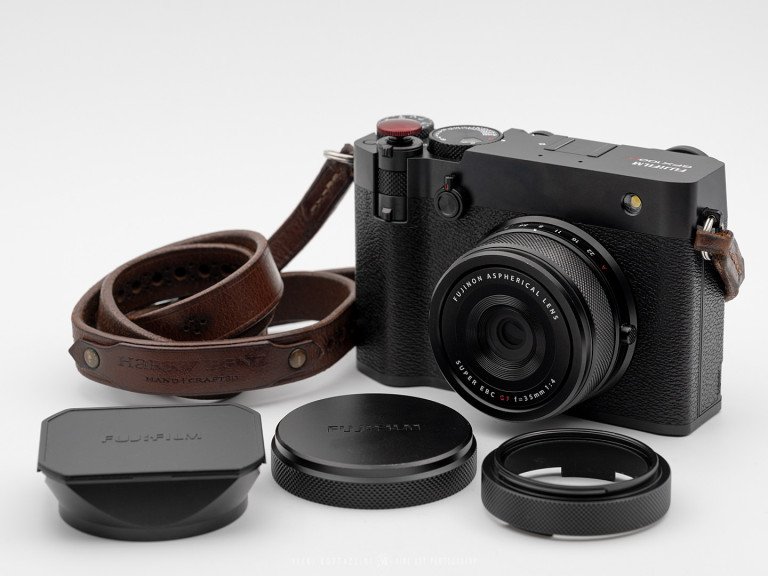
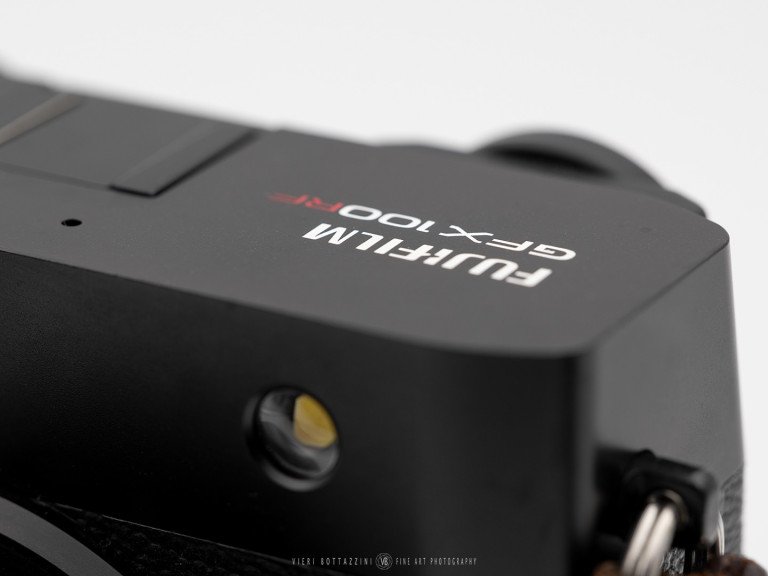
Build | The GFX100RF feels extremely solid and well built; most importantly for what I do, using the filter adapter ring makes it weatherproof, which is something that definitely makes me feel more comfortable when I am out in the field.
Keeping the filter adapter ring on the camera all the time, though, means that you will either need to use FujiFilm’s provided lens hood and cap, which I don’t need nor want to do, or buy a 49mm lens cap which is not included in the otherwise complete GFX100RF packaging.
My setup: when in the field, I always leave the filter adapter ring on the camera, together with a 49-82mm step-up ring with a magnetic inlay and a magnetic cap. This will make sure that the lens is protected, the camera is weatherproof and it is ready to use my magnetic 82mm filters.
Physical controls | The GFX100RF controls have been designed taking a nod to the rangefinder cameras of old, and are almost identical to the FujiFilm X100 VI, the latest iteration of a camera I owned and loved when it first came out.
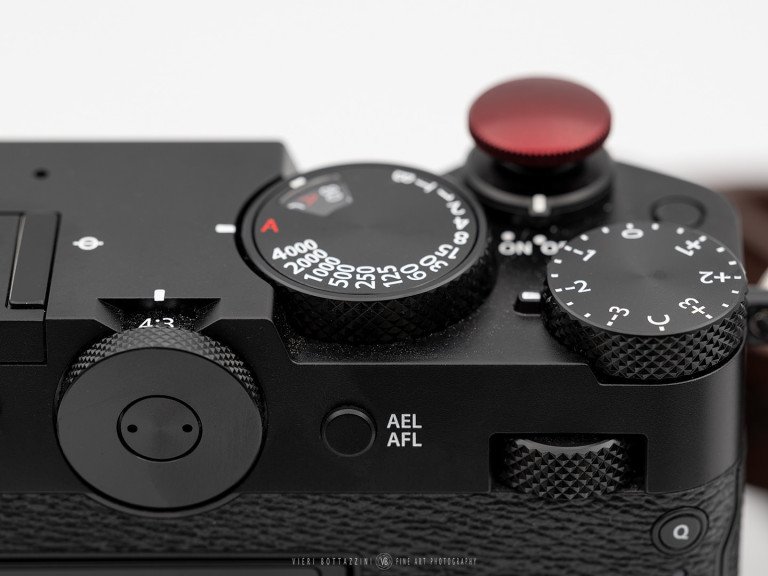
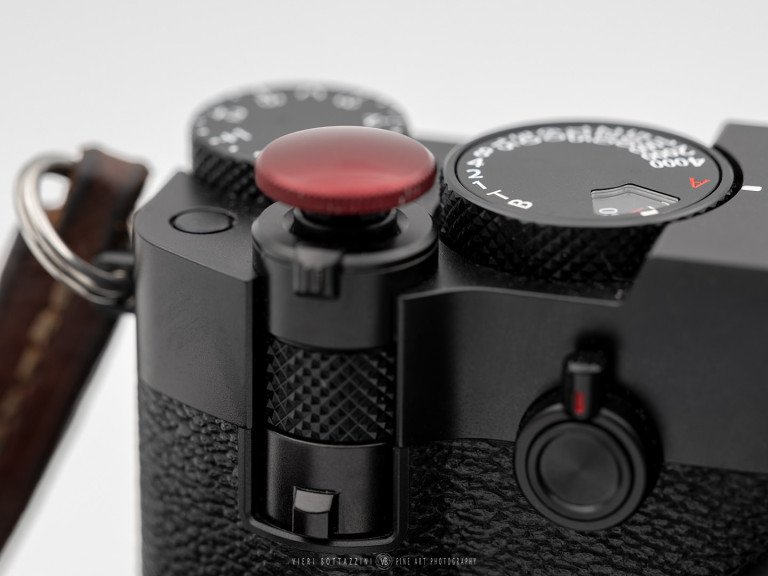
The lens features an aperture ring, and there is a shutter speed ring on top of the camera, with an ISO selector inside. All feature an “A” position, allowing you to use the camera in Aperture, Shutter or ISO priority (or, if you set them all to A, in fully automated mode). As well, there is an exposure compensation wheel on top of the camera if you need it.
My setup: for my work, I either use Aperture mode or Manual (T for long exposures). Both can be set extremely intuitively using the physical controls on the camera, allowing me to swap from one to the other real fast.
The zoom rocker, sitting under the front wheel, is a clever solution to activate the digital zoom and circle through the different “virtual focal lengths”. I do not use the digital zoom for my work, but it’s great to have it, and the rocker is perfectly placed if you need it.
The Image Ratio selector is one of the defining features of the GFX100RF. I love the idea, and I think that having the ability to change image ratios in the field at the flick of a finger is great. My only qualm about the image ratio selector is that it works only when shooting RAW + Jpg.
I routinely shoot RAW only instead, and since when shooting in RAW + Jpg the RAW file carries image ratio information and ACR honours them, I do not see why the camera could not let you activate the image ratios even when shooting RAW only.
My setup: I decided to set the camera on RAW + Jpg at the Jpg’s smallest setting to be able to use the image ratio selector in the field, hoping that FujiFilm will change this behaviour and allow the image ratio selector to work even when shooting RAW only in a future Firmware update.
AEL/AFL & Focus | The camera has a s/c/m selector on the back, allowing you to move between single, continuous and manual focus modes with a click. It also has an AEL/AFL button, to lock exposure or focus.
My setup: Using heavy ND filters, it is paramount for me to have the ability to decouple the shutter button from activating auto-focus. Setting the GFX100RF to “m” on the focus switch will turn the camera into manual focus mode; the AEL/AFL button will activate auto-focus in this mode, and half-pressing the shutter will activate AEL. Perfect for my work!
The screen | The GFX100RF features a tilting LCD screen, allowing you to use the camera comfortably when very low on the ground on a tripod. Unfortunately, the screen only tilts up and down, offering little help if you shoot in portrait mode.
Film presets | FujiFilm is well known for their wide offer of film presets, mimicking the look of Fuji emulsions; I love having separate monochrome and Acros presets, and I only wish that selecting those would somehow be carried into ACR.
My setup: I decided to leave the camera on monochromatic, which features a lower contrast than Acros. While the Jpg accompanying it honours the black & white profile, the RAW does not; since I photograph in black & white only, however, that is not a huge problem for me – I just need to convert all my RAWs upon import and I am good to go.
Long exposures | The GFX100RF features exposure times up to 60 minutes, making it the perfect solution for my Fine Art work. As well, it features a physical cable release thread in the shutter button, making using T and B modes extremely easy.

MY PLAN FOR THE MONTHS AHEAD | Courtesy of FUJIFILM ITALY, I will be able to keep the GFX100RF until we are back home from our traveling season, in late March. Over the next months, I am planning on using the GFX100RF side-by-side my large format kit, creating a Portfolio of images leveraging on the unique qualities (or constraints, if you consider them as such) of the camera.
In particular, I am looking forward to having a fixed lens, 28mm camera – one of my favourite focal lengths – outputting 100Mp of Medium Format goodness in a very small and compact package.
I will use the camera as close as possible to the way I work with my 4×5” kit; slowly, deliberately and in B&W only. I will try and develop my GFX100RF photograph as I go, if possible, and share them with you in location-based batches from the road.

Since I am not particularly interested in a digital vs film comparison, in terms of subject matter and resulting Portfolios I decided to go for a complementing rather than comparing approach. This means that I will not try and photograph the same subject with the same focal length both with film and with the GFX100RF – in fact, I will not even carry a lens with a focal length equivalent to the GFX100RF’s.
Given the very different nature of digital and film photography, in terms of look, feel and mood, it will be very interesting for me to use both medium side-by-side – each for their respective strengths – and see what they will inspire me to shoot.
In May 2026, I published my FUJIFILM GFX100RF REVIEW, sharing with you my findings after using the camera day-in, day-out in the field for 6 months doing the Fine Art landscape work I do, hoping you will find it interesting.
Once again, let me extend my thanks to the people at FUJIFILM ITALY for their kindness in lending me the GFX100RF for the next months ahead – I am looking forward to trying it in the field and see what I can do with it!

Thank you for reading this post, I hope you enjoyed it! Why don’t you share it with your friends, or drop me a comment to let me know your thoughts about this?
2 thoughts on “FINE ART LANDSCAPE & GFX100RF: A FIRST LOOK”
Hi Vieri
I bought the same Fuji camera a few months ago, as a complement to my Hasselblads . My most appreciated tool over the years was the XPan, basically also a Fuji camera , and I wanted to recreate the experience with the 65.24 panoramas , a format that I learned to love over the years for landscape images. well, the new Fuji offers that and a lot more, I use it as a light hiking compagnon , it weights not more then a Leica q, and creates files that look almost like the Hasselblad files. However, I must say that I like the Hasselblad colours a lot more then the Fuji coolers, I tried their film simulations, but I come always back to the Hasselblad colours. For BW it’s fantastic, for colours it is far from bad, but I just find the Hasselblad colours much more natural , just better. So I tried to find a preset to make the Fuji Raws look like Hasselblad, but until now I just did not succeed. Maybe you have a tip? beside this camera is a dream for landscape photography, it just could have IBIS and the panorama function found on cheaper APS Fujis. So I am curious to see your fotos.
for the USA…. we did last year the same trip to Washington and the Oregon coast, as we used to travel 1-2 times a year to the states. As you say, the landscape is just fantastic in Oregon or the national parcs , I just loved the slot canyons in the Navajo reservation, but the country has changed. I am not in politics , but we found the people also changed, hotels are not as we were used to, service was often lousy, restaurants and food have become very pricey, However the experience in the indian reservation Quileute beach and the photo opportunities there was just unique. But, considering the flight, the immigration regulations, the prices, getting older….and comparing to European places, we took this autumn a photo trip to the Swiss national parc and the glaciers around St Moritz, of course with the Fuji 100RF, my photographs of the mountains spots were superb ( I did BW with NIK filters) and I had the chance to meet a Swiss professional glacier photographer in the mountain retreat who gave me useful tips. The light camera is a very useful tool in high mountains, it’s light portable and resisted well to the climate conditions in a blizzard.
so do not let us wait too long with your photos.
Hello Michel,
thank you for your comment and for sharing your story with me, much appreciated. I am glad you are enjoying your GFX100RF and its image ratio modes, something which when the camera came out I thought more as gimmicks, but I grew to really love when using it. While of course one can crop any camera’s files into any ratio, I found that it is truly inspiring to be able to preview the final ratio in camera, and being able to flick through different ratios by a click of the dial it’s just great. In a way, it brought me back to the experience of using the film cameras of old: 6×6, X-Pan, 4×5″, and so on…
About colours, I see your point and I can easily see how there is a large component in that that is very personal. I used to love the X1D’s RAW colours, and working with them was an absolute joy; when I moved to Phase One – as amazing as the camera is! – I loved everything about it, resolution, Frame Averaging, the tech camera ethos and all; but, I could never get to love P1’s RAW’s colours right off the camera. Of course, once I got used to working with them, I could make the RAW to look exactly what I wanted it to look; as I am sure one could do that starting with any RAW, if one knew what one was doing.
That said, every camera (Nikon, Canon, Sony, Fujifilm, Hasselblad, etc) comes with a different built-in colour palette / contrast palette / hues palette / etc, and it is only natural that we all prefer one or the other.
Thank you for your words about my photos, I hope to have some to show soon – but, I am afraid they will all be in B&W, so I don’t think I will be of much help about colours :)
About the US, I absolutely love the landscapes I have been lucky enough to seen and work on during my trips there – they are just unbelievable. About traveling there, I have been truly privileged in that I had the opportunity to visit multiple times over the last 15 years (nearly every year, in fact, Covid aside!), and photograph those incredible landscapes multiple times. We made the decision to stop our Workshops there, and stop traveling there for photography overall, in 2023 – way before the current political climate, and not influenced by any of it. I hope nobody will see the following as offending, and I certainly don’t mean it as such, but I can easily see your point regarding hotels, service, food and so on, especially when approached in terms of value for money compared to Europe.
I loved every day I spent photographing the US, but I am happy to have closed that chapter of my career and I am very much looking forward to exploring and photographing new, amazing locations elsewhere in the future!
Best regards,
Vieri